
 E-Submission
 Yeungnam University College of Medicine
Indexed in: ESCI, Scopus, PubMed,
PubMed Central, Embase, CAS, KCI
PubMed Central, Embase, CAS, KCI
FREE article processing charge

Search
- Page Path
- HOME > Search
Original article
- Endocrinology, Diabetes, and Metabolism
- Adult height in girls with central precocious puberty without gonadotropin-releasing hormone agonist treatment: a retrospective case-control study
-
Hyun Ji Jang
 , Min Jung Kwak, Young Mi Kim, Soo-Han Choi, Kyung Hee Park, Hye Won Yoo, Su Jeong Park, Yoon Hee Jo, Ha Young Jo
- J Yeungnam Med Sci. 2023;40(Suppl):S81-S86. Published online November 7, 2023
- DOI: https://doi.org/10.12701/jyms.2023.00801
- 20,654 View
- 128 Download
- 5 Web of Science
- 6 Crossref
-
 Abstract
 PDF
- Background
The primary aim of this study was to investigate the final adult height (FAH) of girls diagnosed with central precocious puberty (CPP) who were untreated.
Methods
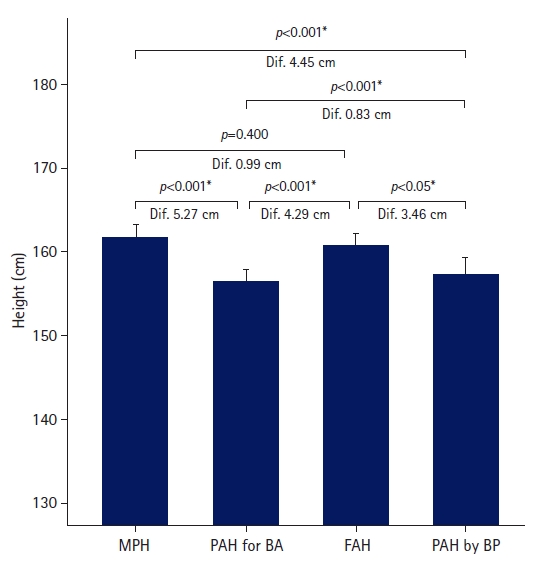
We retrospectively analyzed the medical records of 36 girls diagnosed with CPP between 8 and 9 years of age who did not receive treatment, and 206 girls diagnosed with CPP within the same age range who received gonadotropin-releasing hormone (GnRH) agonist treatment. Midparental height (MPH), predicted adult height (PAH) obtained using height and bone age (BA) at the time of diagnosis (PAH for BA), and PAH obtained using the Bayley-Pinneau method (PAH by BP) were calculated. Additionally, height at the time of growth completion was compared with the predicted height.
Results
The FAHs were 160.71±4.56 cm in the untreated group and 159.31±4.26 cm in the treated group. In the untreated group, the FAH was 0.99±4.50 cm shorter than the MPH but 4.29±3.33 cm and 3.46±3.93 cm greater than the PAH for BA and PAH by BP, respectively.
Conclusion
In children diagnosed with CPP between 8 and 9 years of age who were untreated, FAH was greater than PAH for BA and PAH by BP at the time of diagnosis, indicating that the prognosis of FAH was not poor. Therefore, for girls diagnosed with CPP, it is recommended to consider various conditions, such as pubertal onset, height at diagnosis, BA, peak luteinizing hormone level, predicted height, and speed of puberty, when deciding whether to administer GnRH agonists. -
Citations
Citations to this article as recorded by
- Central precocious puberty: an Endocrine Society clinical practice guideline
Ana Claudia Latronico, Stephanie A Roberts, Morgan Alonzo, Jesús Argente, Ana Pinheiro Machado Canton, Jean-Claude Carel, Fernando Cassorla, Evangelia Charmandari, Erica A Eugster, Anna Grandone, Louise C Greenspan, Elizabeth C Hawse, Anders Juul, Paul B
The Journal of Clinical Endocrinology & Metabolism.2026; 111(8): 2101. CrossRef - Development and validation of diagnostic prediction models for central precocious puberty in girls based on machine learning: a multicenter retrospective study
Wenyong Wu, Zhe Su, Haiyan Wei, Yanhong Li, Benlong Zhu, Xin Yuan, Daibin Lei, Yi Wei, Xian Wu, Hanghan Ou, Xinyu Chen, Ziling Zhu, Ruimin Chen
Frontiers in Endocrinology.2026;[Epub] CrossRef - A systematic review supporting the Endocrine Society clinical practice guidelines on central precocious puberty
Mohammed Firwana, Neha Ramachandran, Adel Kabbara Allababidi, Laura E Billstein, Vishal P Shah, Satya Sai Sri Bandi, Shubhangi Bagewadi, Sameh Taki Aldin, Ayla Shamsi Basha, Alaa Al Nofal, Larry J Prokop, Ana Claudia Latronico, Stephanie A Roberts, M Hass
The Journal of Clinical Endocrinology & Metabolism.2026; 111(8): 2145. CrossRef - Height benefits after GnRHa treatment in girls aged over 6 years with central precocious puberty: a meta-analysis
Ming Chen, Jie-yu Sun, Xing Ji, Ming-ming Ni
Endocrine.2025; 89(3): 686. CrossRef - Comparison of Methods Used for Final Height Prediction in Central Precocious Puberty Patients
Nisa Nur Turan, Aşan Önder Çamaş, Burçin Çiçek, Merve Nur Hepokur, Hamdi Cihan Emeksiz
Journal of Clinical Research in Pediatric Endocrinology.2025;[Epub] CrossRef - LONG TERM CONSEQUENCES OF PRECOCIOUS PUBERTY - EXPLORING HEALTH, METABOLIC, AND PSYCHIATRIC CHALLENGES
Justyna Popczyńska, Agnieszka Raczyńska, Natalia Pacocha, Oliwia Krzemień, Kinga Kosiec, Jakub Jędrychowski, Natalia Karpowicz, Julia Kaszucka, Małgorzata Krzyżanowska, Marta Zgierska
International Journal of Innovative Technologies in Social Science.2024;[Epub] CrossRef
- Central precocious puberty: an Endocrine Society clinical practice guideline
Original Article
- Cardiology and Cardiovascular Medicine
- Meta-analysis on risk stratification of malignant ventricular tachyarrhythmic events in arrhythmogenic right ventricular cardiomyopathy
-
Young Eun Roh, Hyun Ji Jang, Min Jung Cho
- Yeungnam Univ J Med. 2017;34(2):208-215. Published online December 31, 2017
- DOI: https://doi.org/10.12701/yujm.2017.34.2.208

- 3,919 View
- 10 Download
-
Abstract
PDF
- BACKGROUND
Arrhythmogenic right ventricular cardiomyopathy (ARVC) is a cardiomyopathy characterized by predominant right ventricular fibro-fatty replacement, right ventricular dysfunction and ventricular arrhythmias. It is a rare but important cause of sudden cardiac death in children and young adults. A meta-analysis on risk stratification of major ventricular tachyarrhythmic events indicating the need for implantable cardioverter defibrillator therapy in ARVC was performed. METHODS: The pubmed database was searched from its inception to May 2015. Of the 433 citations identified, 12 were included in this meta-analysis. Data regarding major ventricular tachyarrhythmic events were retrieved in 817 subjects from the studies. For the variables, a combined odds ratio (OR) was calculated using a fixed-effects meta-analysis. RESULTS: Extensive right ventricular dysfunction (OR, 2.44), ventricular late potential (OR, 1.66), inducible ventricular tachyarrhythmia during electrophysiology study (OR, 3.67), non-sustained ventricular tachycardia (OR, 3.78), and history of fatal event/sustained VT (OR, 5.66) identified as significant risk factors (p < 0.0001). CONCLUSION: This meta-analysis shows that extensive right ventricular dysfunction, ventricular late potential, inducible ventricular tachyarrhythmia during electrophysiological study, non-sustained ventricular tachycardia, and history of sustained ventricular tachycardia/fibrillation are consistently reported risk factors of major ventricular tachyarrhythmic events indicating implantable cardioverter defibrillator therapy in patients with ARVC.
 First
 Prev




