
 E-Submission
 Yeungnam University College of Medicine
Indexed in: ESCI, Scopus, PubMed,
PubMed Central, Embase, CAS, KCI
PubMed Central, Embase, CAS, KCI
FREE article processing charge

Search
- Page Path
- HOME > Search
Original articles
- Geriatrics and Gerontology
- Long-term supplementation with a combination of beta-hydroxy-beta-methylbutyrate, arginine, and glutamine for pressure ulcer in sedentary older adults: a retrospective matched case-control study
-
Igor Kisil
 , Yuri Gimelfarb
- J Yeungnam Med Sci. 2023;40(4):364-372. Published online February 16, 2023
- DOI: https://doi.org/10.12701/jyms.2022.00899

- 11,750 View
- 282 Download
- 7 Web of Science
- 5 Crossref
-
 Abstract
 PDF
- Background
Growing evidence suggests that beta-hydroxy-beta-methylbutyrate (HMB), arginine (Arg), and glutamine (Gln) positively affect wound recovery. This study investigated the effects of long-term administration of HMB/Arg/Gln on pressure ulcer (PU) healing in sedentary older adults admitted to geriatric and rehabilitation care facilities.
Methods
This was a pilot retrospective case (standard of care and HMB/Arg/Gln)-control (standard of care alone) clinical study. Outcome measures were relative healing rates and Pressure Ulcer Scale for Healing (PUSH) scores (calculated after 4, 8, 12, 16, and 20 weeks) and time to healing.
Results
The study subpopulation was comprised of 14 participants (four males, 28.6%) with the median age of 85.5 years (interquartile range [IQR], 82.0–90.2 years). The control subpopulation was comprised of 31 participants (18 males, 58.1%) with the median age of 84.0 years (IQR, 78.0–90.0 years). At the beginning of follow-up, there were no statistically significant demographic (sex and age) and clinical (main diagnosis, baseline area, and PU perimeter) differences between the groups. During the study period, there were no significant differences in the relative healing rates and PUSH scores between the subpopulations. The median time to complete healing in the study and control populations was 170.0 days (95% confidence interval [CI], 85.7–254.3) and 218.0 days (95% CI, 149.2–286.7) (log-rank, chi-square=3.99; p<0.046), respectively.
Conclusion
More than 20 weeks of HMB/Arg/Gln supplementation had a positive effect on difficult PU healing in older adults with multiple comorbidities. -
Citations
Citations to this article as recorded by
- Protein-Based Nutrition for Chronic Wounds: A Clinician’s Guide to Patient Selection, Dosing, Monitoring, and Outcomes
Zilong Tan, Yi Ru, Caiyun Zhang, Xinxin Wu, Qingkai Liu, Bin Li, Qilong Chen
Advances in Wound Care.2026;[Epub] CrossRef - Use of an Oral Nutritional Supplement Containing Calcium Beta-Hydroxy-Beta-Methylbutyrate (CaHMB), L-arginine, and L-glutamine May Have Helped Avoid Surgery That Could Have Led to Short Bowel Syndrome: A Case Report
Atsushi Hirose, Tomoya Tsukada, Koji Amaya, Masahide Kaji, Misaki Fujimoto
Cureus.2026;[Epub] CrossRef - The Role of Glutamine and Arginine in Wound Healing of Pressure Ulcers: A Systematic Review
Tim Torsy, Inge Tency, Dimitri Beeckman, Kirsi Isoherranen, Mary Litchford, Flore De Vylder
Wound Repair and Regeneration.2025;[Epub] CrossRef - Wound Healing Potential of a Formulation Containing Yerba Mate (Ilex paraguariensis) Extract: A Preclinical Study in a Rat Model of Undernutrition
Andrea Lorena Berengeno, Juan Garona, Facundo Jose Salinas, Eduardo Matias Belotti, Daniel Fernando Alonso, Natalia Raquel Salvetti, Hernan Farina, Hugo Hector Ortega
Journal of Food Science.2025;[Epub] CrossRef - Impact of oral nutritional supplement composition on healing of different chronic wounds: A systematic review
Allan Carlos Soares do Espírito Santo, Clara Sandra de Araújo Sugizaki, Alcides Corrêa de Morais Junior, Nara Aline Costa, Maria Marcia Bachion, João Felipe Mota
Nutrition.2024; 124: 112449. CrossRef
- Protein-Based Nutrition for Chronic Wounds: A Clinician’s Guide to Patient Selection, Dosing, Monitoring, and Outcomes
- Alternative Medicine
- Auricular acupuncture for sleep quality in participants with mental and behavioral disorders due to prior multiple drug use: a retrospective consecutive case series
-
Yuri Gimelfarb, Eran Goldstien
- J Yeungnam Med Sci. 2023;40(1):78-85. Published online November 28, 2022
- DOI: https://doi.org/10.12701/jyms.2022.00542
- 13,552 View
- 170 Download
- 3 Web of Science
- 3 Crossref
-
Abstract
PDF
- Background
Poor sleep quality is associated with psychoactive substance abuse/addiction/withdrawal. Auricular acupuncture (AA) is a nonpharmacological method used for the treatment of sleep disturbances. This study aimed to examine the quality of sleep before and after AA in participants with mental and behavioral disorders due to prior multiple drug use in the therapeutic community.
Methods
This was a consecutive case series of 27 participants (25 male [92.6%]). The median age was 35.0 years (interquartile range [IQR], 29.0–37.2 years), methadone/buprenorphine were not used, and the participants were treated with AA (median number of treatments, 15.0 [IQR, 12.0–18.0]) during a median period of 51.0 days (IQR, 49.0–51.0 days) according to the National Acupuncture Detoxification Association (NADA)-Acudetox protocol. Sleep quality was determined using the Pittsburgh Sleep Quality Index (PSQI), a self-rated questionnaire that assesses sleep quality and disturbances over a 1-month interval.
Results
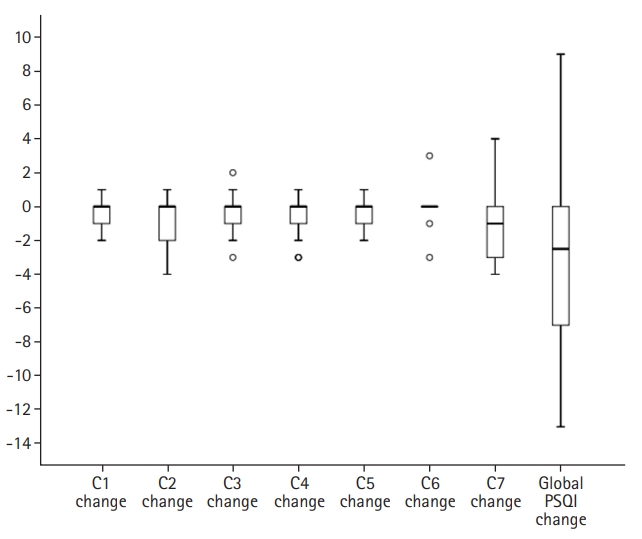
The global PSQI score dropped (indicating better sleep quality) by a median of 3.0 points (IQR, 0.0–8.0 points) after treatment. In the multivariate logistic regression analysis, with an increase in global PSQI score during AA by 1 point, there was a 0.73-fold reduction in the risk of poor sleep quality post-AA (adjusted odds ratio, 0.73; 95% confidence interval, 0.52–1.01; p<0.055; Nagelkerke's R2=0.66).
Conclusion
The results revealed a positive effect of AA (by the NADA-Acudetox protocol) on sleep quality (as measured by PSQI) among participants in a treatment center with mental and behavioral disorders due to multiple drug use. -
Citations
Citations to this article as recorded by- Feasibility of Auricular Acupressure Therapy for Neuropathic Pain in Cancer Patients
Eunhea You, William Holzemer, Xiaomei Cong, Hermine Poghosyan, Heon Joon Lee, Jeffrey Paul Aleski
Pain Management Nursing.2026; 27(4): e540. CrossRef - Auricular Acupuncture for Stress and Anxiety in Correctional Staff: A Pilot Feasibility Study in a High-Security Psychiatric Unit
Konstantinos Georgiadis, Giorgos Tzigkounakis, Vasileios Giannakidis, Athanasios Douzenis
Medical Acupuncture.2026;[Epub] CrossRef - Auricular Acupressure for Perioperative Anxiety and Pain in Therapeutic Breast Surgery: Protocol for a Randomized Clinical Trial
Mirela Bilc, Eva Beiner, Johanna Triana, Irene Rubio Rodríguez, Anja Birmanac-Pflüger, Holger Cramer, Marcela Winkler
JMIR Research Protocols.2026; 15: e97469. CrossRef
- Feasibility of Auricular Acupressure Therapy for Neuropathic Pain in Cancer Patients
 First
 Prev




